
Before and after architecture
Same knowledge. Different operating system.
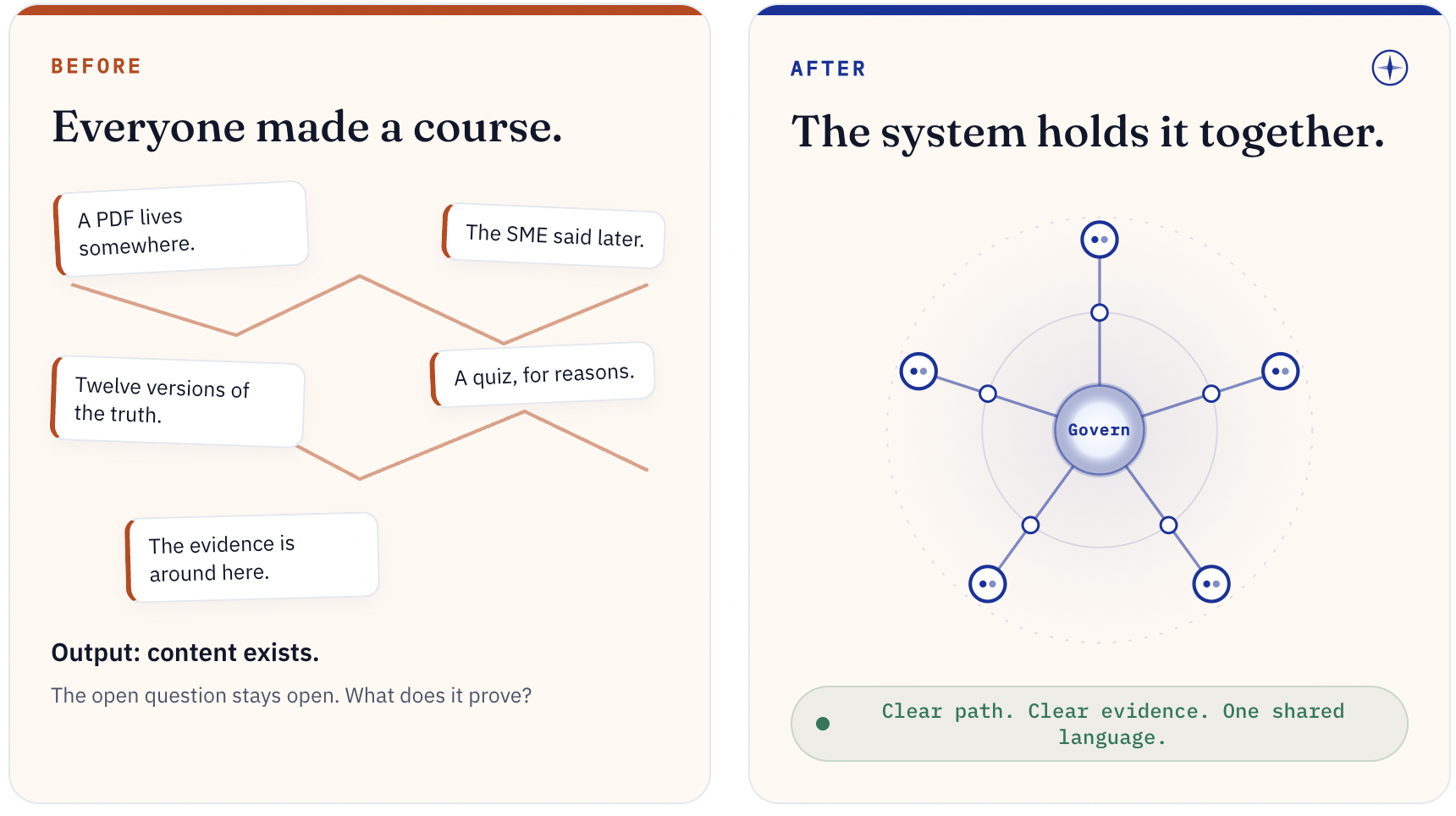
Most organizations already hold the knowledge. The files exist. The courses exist. The expert explanations exist, usually under a filename nobody remembers. The work of learning architecture begins one step later. It gives that knowledge a structure people can navigate, trust, measure, and improve.
Content accumulates
A product ships, so someone builds a course. A team asks for enablement, so someone builds a course. A certification needs support, so the library grows again. Modules, recordings, job aids, quizzes. On the surface this reads as productivity.
Underneath, the same topic appears in five places. Five subject matter experts describe the same process five ways. A learner finishes the training holding information, and the decision it should inform stays undefined. Completion data arrives on schedule. Evidence of real capability stays scarce.
A system gives it direction
Learning architecture asks a sharper question. What capability are we building? For whom, in which role, for which task, under which conditions? What evidence shows readiness, and what does success look like inside the real workflow?
Technical learning rewards this precision. In cybersecurity, SaaS enablement, customer education, and certification design, people interpret, decide, troubleshoot, recover, escalate, and explain. They need a pathway, and architecture draws it. It makes expert knowledge visible, holds foundational knowledge apart from applied judgment, connects learning objectives to operational tasks, and aligns each assessment with the evidence it is meant to produce.
Organization is strategy
Good organization looks simple once it exists, which is exactly why it stays underrated. A well-structured learning system reduces ambiguity. It shows learners where they stand and what they build toward. It shows experts how their knowledge fits a larger design. It gives leadership a clear read on whether training builds capability or produces completion records.
Technical environments raise the stakes. When products evolve, the system evolves with them. When roles shift, the pathways adjust. When certification expectations grow, the evidence stays defensible. That result comes from architecture, by design.
The quiet part is a coordination problem
Here is the part the diagram keeps to itself. A certification rarely stalls for lack of expertise. It stalls because each specialist speaks a fluent, precise, local language. Methodology speaks one. Delivery speaks another. Subject matter experts speak a third. Governance speaks a fourth. Every voice points at the same goal and describes it in different words.
Learning architecture supplies the shared grammar that lets those languages combine into one credential, with each contribution placed where it operates. Who brings which piece, in which form, by when, to which standard. The architect earns that seat through fluency in every one of those languages, which is what makes translation between them possible. This is stakeholder alignment expressed as design, and cross-functional coordination made visible.
Same knowledge, different operating system
The distance between before and after is rarely the amount of knowledge. Often the same knowledge sits in both frames. The difference is structure.
A repository stores what exists. A system arranges it into levels of knowledge, so a learner moves from ready entrant to certified expert along a path that proves itself at each step. Before, the question is where the file lives. After, the question is which capability it builds. One record proves attendance. The other provides evidence of readiness. That is the value of learning architecture, and the reason organization deserves to be read as strategy.
Less “where is that file?” energy.
 My Compass Journey | Learning Architect and Psychologist